// Why we transformed
Everyone has AI. Hardly anyone has changed anything.
On paper, New Zealand is done. Datacom's 2026 State of AI Index says 91% of NZ businesses have adopted AI. Read on and only 4% use it to change how their core operations run. Adobe counts 5.2% of Australian and NZ businesses as "AI leaders".
So most businesses bought the licences and stopped there. We'd know. We were one of them.
185 ChatGPT accounts. Same business.
Before the rebuild, 185 Overdose email addresses were hooked up to ChatGPT. People used them, and used them well. Copy got written faster. Notes got summarised. Ideas got sharper.
The business didn't change one bit. Profit didn't move. Productivity didn't move. Everyone had their own workflows and their own tricks, and none of it was shared. When a good person left, everything they'd figured out left with them.
"If it only lives on our best people's laptops, it's still a hobby."Paul Pritchard, Group CEO
A handful of power users is nice to have. The business doesn't own what they know, and it leaves when they do.
Before · 185 laptops

After · one brain
That was a problem. It wasn't why we moved.
The real reason: selling hours is running out of road
Agencies sell time. Clients are asking, fairly, why they should keep paying for hours when AI keeps shrinking how many hours the work takes. In one survey of UK agencies, 36 to 38% said clients had moved work in-house because of AI. That's UK data. Any agency on this side of the world treating it as someone else's problem is kidding itself.
We can already see it in our own work:
Price by the hour and those numbers are terrifying. Paul's view is that the time saving is the boring part anyway: "Yes, your CFO loves it. But what it doesn't do is it doesn't change your business. It just makes you do work faster."
So we picked a side. AI was going to be our advantage, and we'd rebuild the business around it. That meant how we price, how we deliver, who we hire and where our knowledge lives.
We picked the worst possible time
We were flat out, and we'd just hit some pretty strong profitability. In Paul's words, it "felt like it was the dumbest time to really rip the business up and change it, but it was probably the only time that we could."
Overdose runs on three values: think bigger, get sh*t done, break the rules. Tearing up a business that was working tested all three at once.
Eighteen months. Six moves.
// June 2025 to March 2026
- June 2025: AI-first. We told the whole company we were changing. Not experimenting. Changing.
- October 2025: the first big bet. Enterprise search (Glean) across the whole business. Paul's summary of the cost: "a sh*t ton of money."
- November 2025: Allexive. Our internal AI lab of champions and power users was heading for a slow agency death, so we spun it out as its own company to move at product speed.
- December 2025: a new operating platform, built for agentic workflows.
- February 2026: the Overdose Brain. Claude on top, Google Drive and GitHub underneath, shared skills running through it.
- March 2026: humans guide, AI executes. We rebuilt pricing, roles and values, and every leader had to show how their team would get competent, fast.
// What we learnt
What we got wrong

We made most of the mistakes going. We said we'd be honest about them, so here they are.
We bought search before we built a brain. Six months with an excellent search tool. People found things faster and repeated them back. Nobody worked any differently.
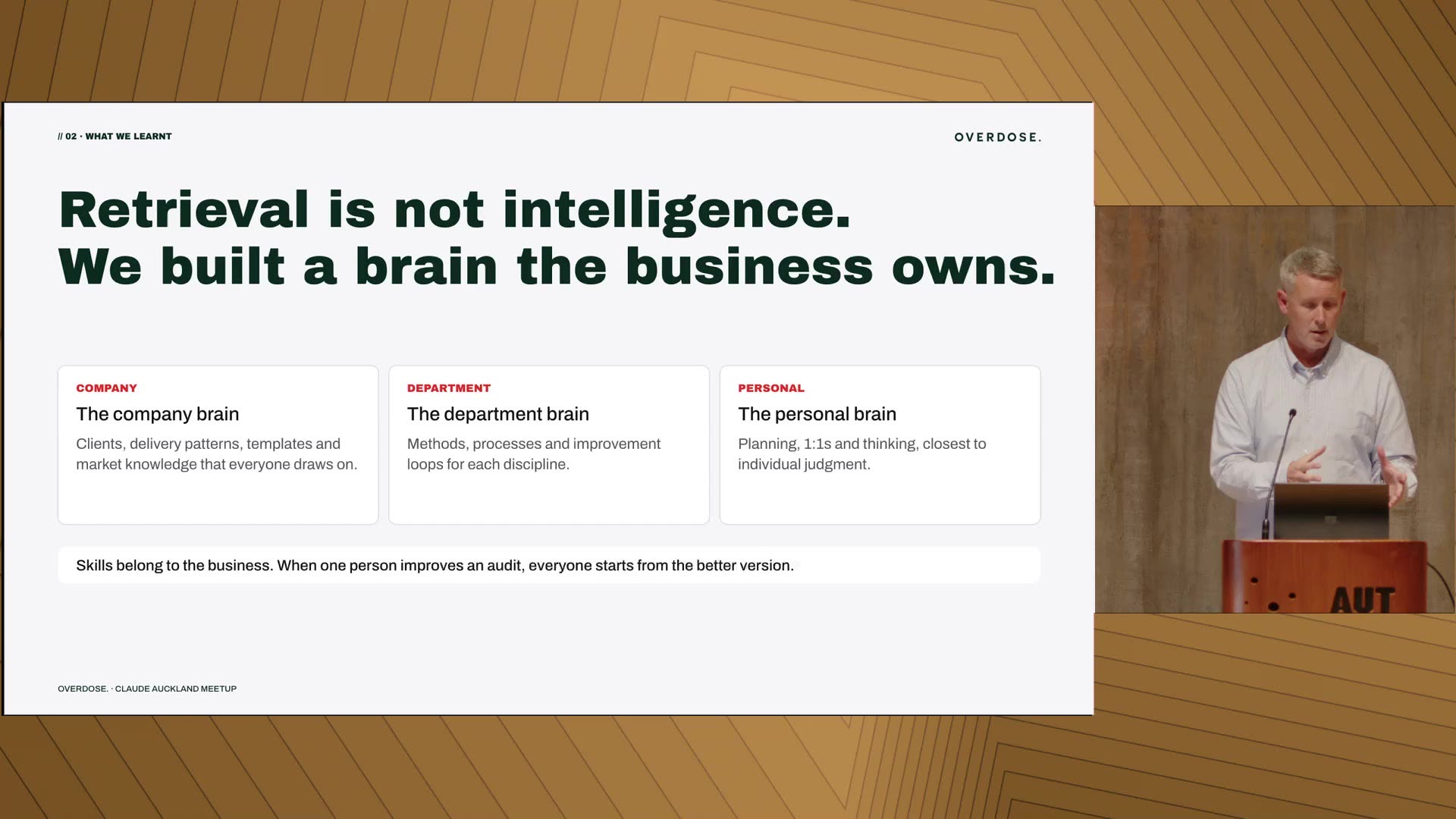
What we needed was a brain the business owns. Ours is plain markdown files on Google Drive, shared skills in GitHub, and Claude as the way in. If Claude stops being the right tool, we pick the lot up and move it. When someone finds a better way to run an audit, a discovery session or a proposal, it becomes a skill, and the next person starts from the better version.
Keeping it clean is harder than building it. Feed a brain average material and you get average work back. The first time that happens, people stop trusting the whole thing. We got strict about what goes in.
Adoption can't be optional. We had revolutionaries and we had resistors, and as Paul put it, "we're only ever as good as the resistors in our business." Everyone gets a path. Everyone is expected to walk it.
Identity takes longer than skills. Some people got very good, very fast, and kept it to themselves. Some turned up with great work and wouldn't say how they'd made it. None of that builds anything for the business. What helped was showing people where they were heading as well as what they were leaving.
What it costs, and how we count it
Paul gave the room real numbers on stage, and usage climbed a lot faster than anyone budgeted for. He isn't complaining. It's a fraction of what the people it would replace would cost, and it means we don't have to keep hiring to take on more work.
It also means AI doesn't belong on the software line of the budget. It's a cost of goods. It grows with the work, so we price it into the work.
We don't manage tokens. The number we watch is turns to artifact, meaning how many rounds it takes to get to something we'd actually use. Thirty rounds and then bin it is thirty rounds of nothing. That number only drops when the skills and the context get better.
// What's next
Every job has changed
Our engineers went first. Operators, then orchestrators, now technical product owners, and some haven't written code in six months. The job used to be the doing: write the copy, build the page, run the report. Now it's the result. Frame the problem, know what good looks like, apply judgment and own the outcome.
"You can't send AI to jail, right? When something goes wrong, a person answers for it."Paul Pritchard, Claude Auckland Meetup
There's a catch. As responsibility goes up, hands-on skill goes down. Airlines make pilots fly part of the route by hand for exactly this reason. So we keep a hand on the work, we make approvals active rather than a reflex, and we train judgment on purpose. You can't spot good work once you've stopped making it.
Coming up in Part 2
The call was made. Part 2 opens up the six moves: what each one cost, what it changed, and which ones we'd do in a different order.
Partway through this yourself and stuck? Come and talk to us. As Paul said at AUT, "this is a story that shouldn't be kept."